We are in the golden era of migrations. Painful migrations that used to take a year are now done in a few months.
By Ramiro Visca, AI Practice Lead at Zaelot
The assumption behind every traditional migration quote
Most traditional CMS migration quotes rest on one assumption: a person has to look at every page. Someone inventories the site in a spreadsheet. Someone copies each page into the new system, fixes the links, re-uploads the images, and rewrites the metadata. Someone else checks a sample of that work, because checking all of it would double the effort.
Under that model, cost and schedule both grow with page count. A site twice the size takes twice the people or twice the months, which is why a needed migration can sit on the roadmap for years.
Agentic workflows change the assumption. At Zaelot, a migration runs as a staged process in which specialized AI agents read, map, transform, and check the content, and every step is validated against rules the team agrees on up front. The page-by-page work moves to agents and automated checks. Senior engineers and your content team spend their time deciding what the content should become.
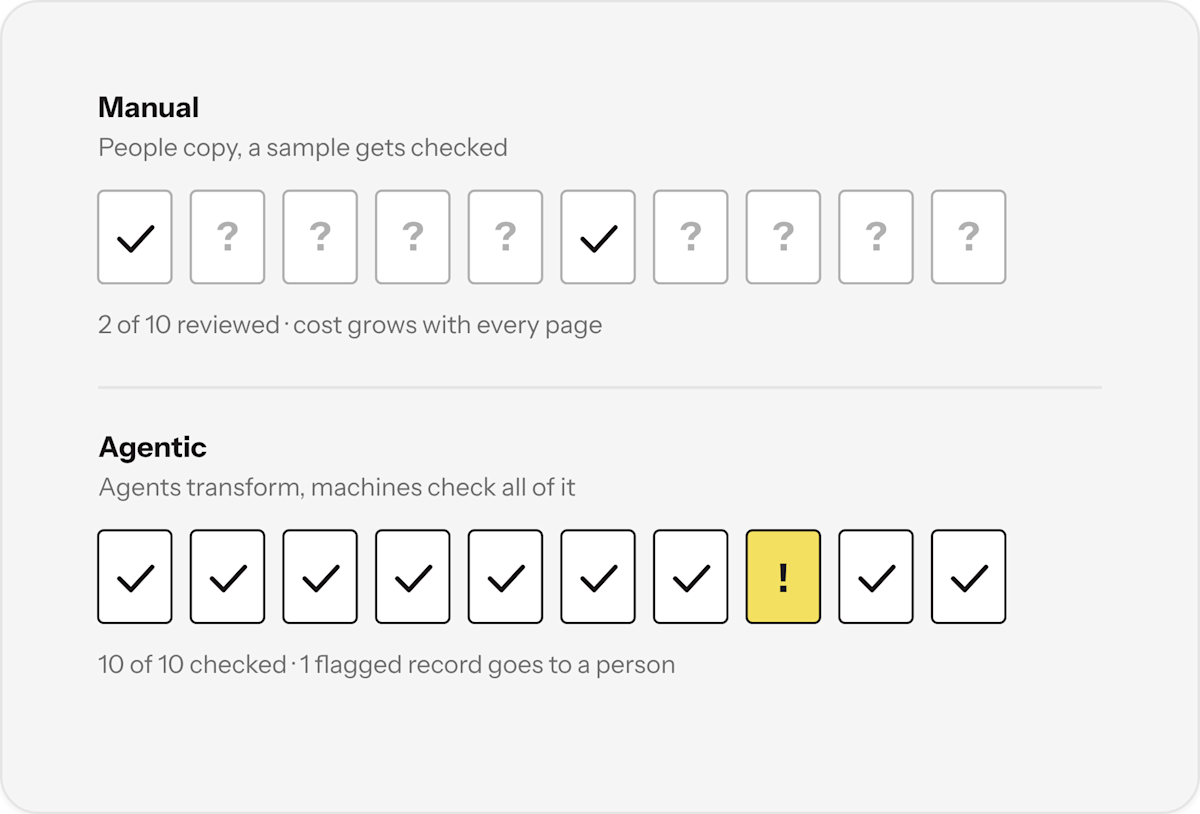
Manual projects check samples. An agentic pipeline checks every page and sends people only the records that need judgment.
The two migrations we see most often
A builder-made site moving to a headless CMS
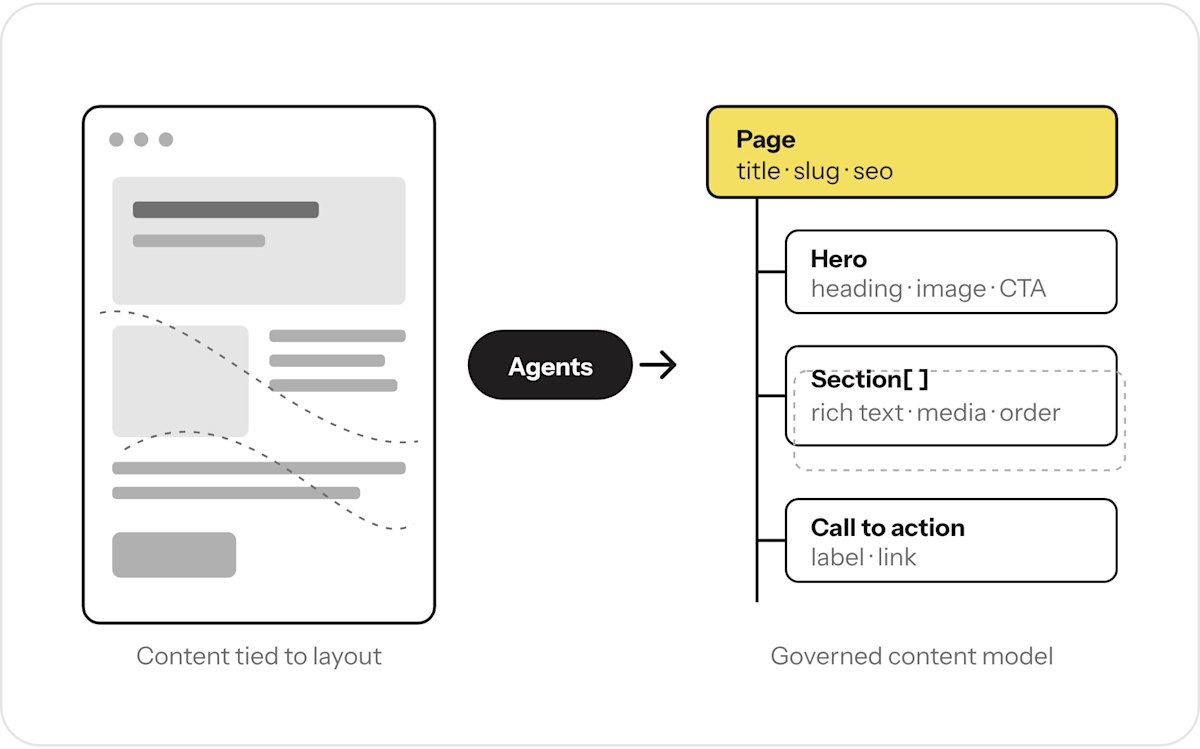
Visual builders and AI site generators (Builder, Framer, and similar tools) are a fast way to get a site live. As the site grows, the content stays tied to the layout. There is no content model, and every edit routes through the one person who knows where things live.
These sites rarely have a clean export, because the structure was never written down. Agents read the rendered pages and the underlying code together, work out that structure, and land the content in a governed model inside a headless CMS that a non-technical team can maintain and extend without a developer.
Several sites consolidated onto one platform
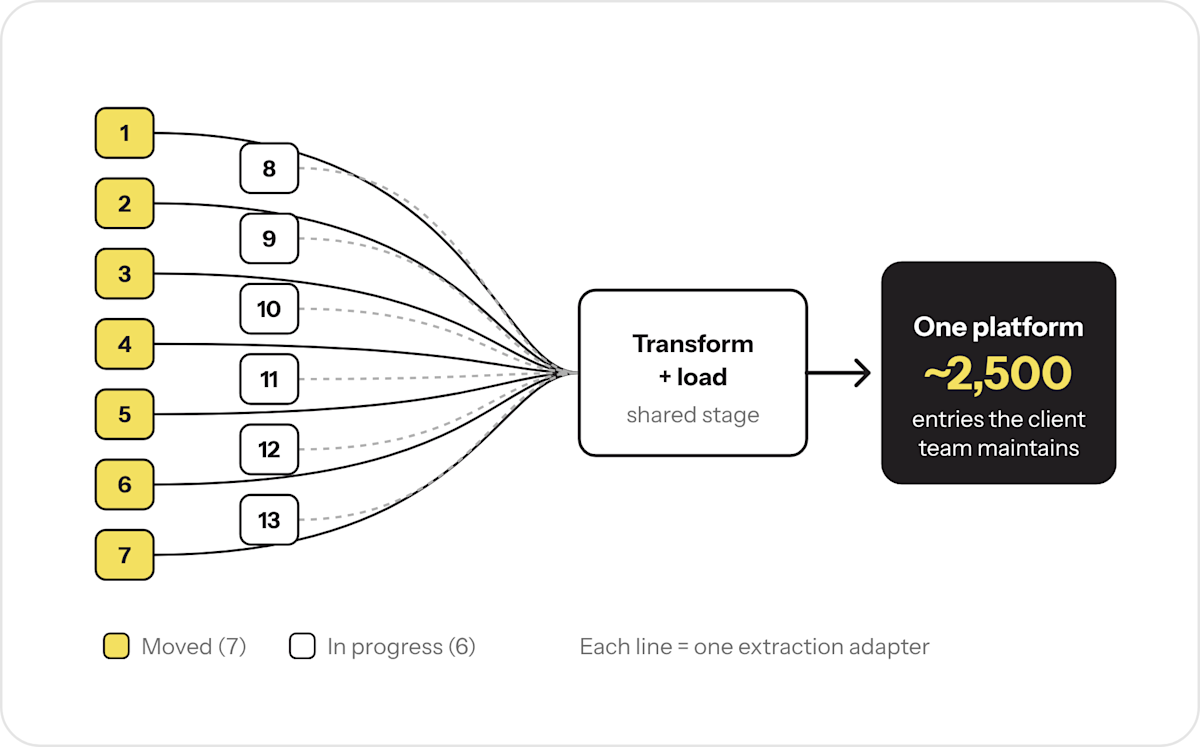
Consolidation multiplies every migration task by the number of source systems. For a global association of healthcare technology executives, Zaelot is bringing 13 sites onto one platform architecture. As of October 2026, seven properties had moved, and the client’s own team now maintains about 2,500 modular content entries.
In an agentic pipeline, each added source system means one more extraction adapter. The transformation and loading stages stay the same.
The destination is your call
Zaelot has a great partnership with Contentful, our agentic migration pipeline was creating having them in mind but can also be used for other CMSs.
The method follows a standard ETL shape: extraction is driven by the source system’s API and documentation, and transformation and loading don’t depend on either platform. Supporting a new source or target means adapting small portions of our pipeline.
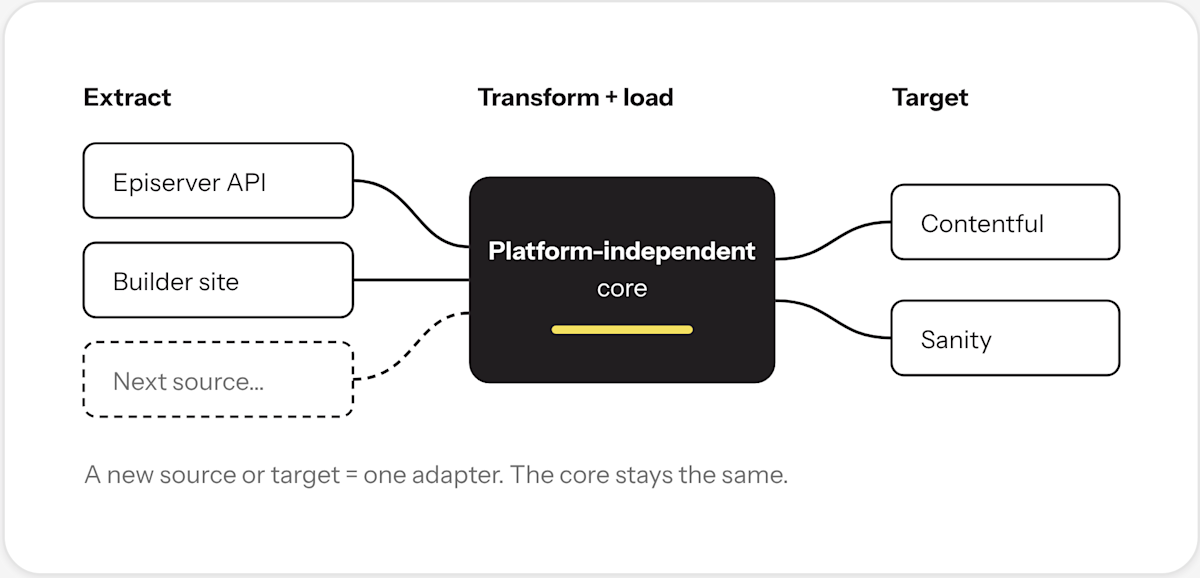
How Zaelot runs an agentic migration
1. Crawl the whole site before planning
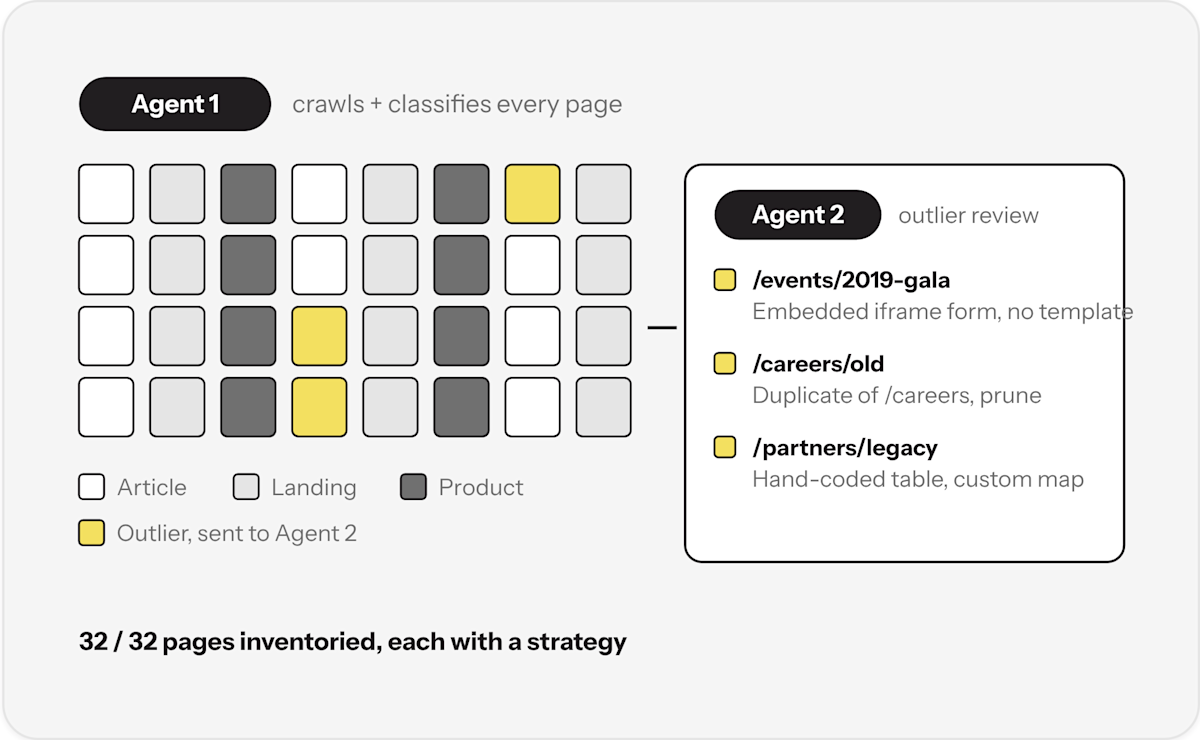
One agent crawls every page and sorts each one against standards set with your team: expected templates, composition, and structure. A second agent reviews the outliers independently and records why each page fell outside the standard.
The inventory covers the full site, so every page enters the migration with an assigned strategy.
2. Write the rules down first
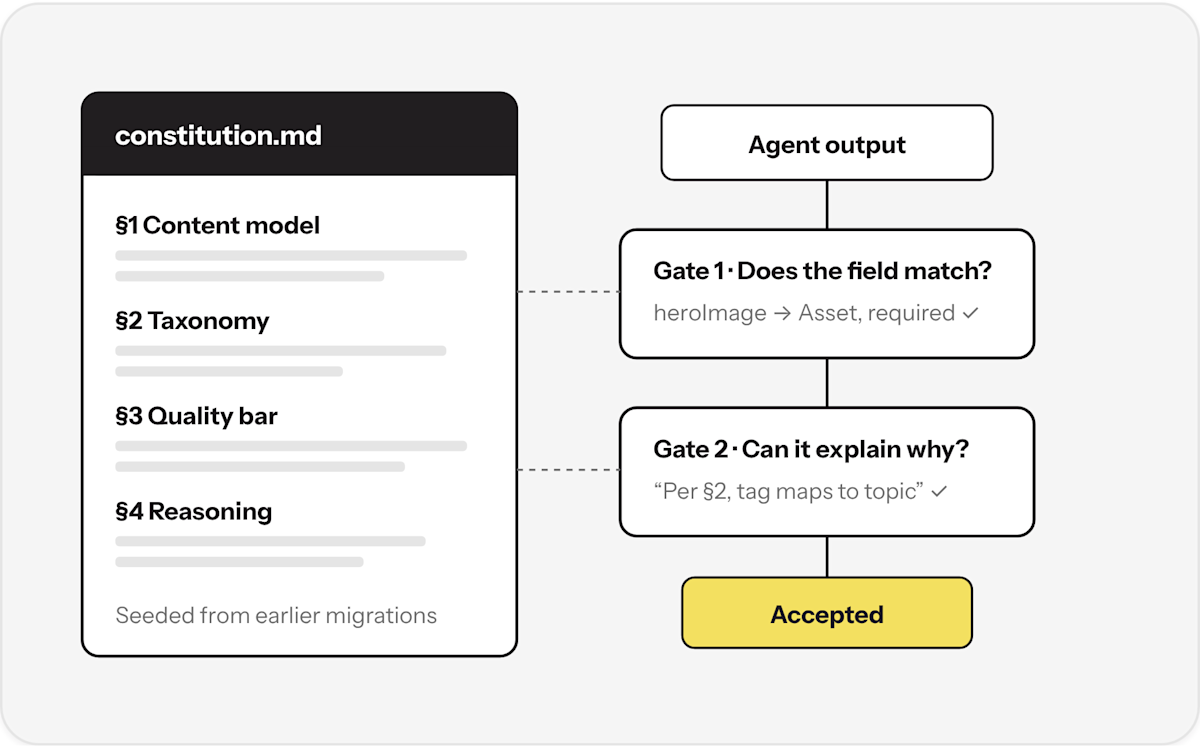
Before any content moves, the team writes a governing content specification, which we call the constitution. It sets out the target content model, the taxonomy, the quality bar, and the reasoning behind each.
Every agent checks its output against it, on two counts: whether the field matches, and whether the agent can explain why the transformation follows the rules. The constitution starts from standards Zaelot has built up over earlier migrations, and our engineers adapt it to each engagement’s sources, model, and priorities.
3. Agents propose mappings, and people decide
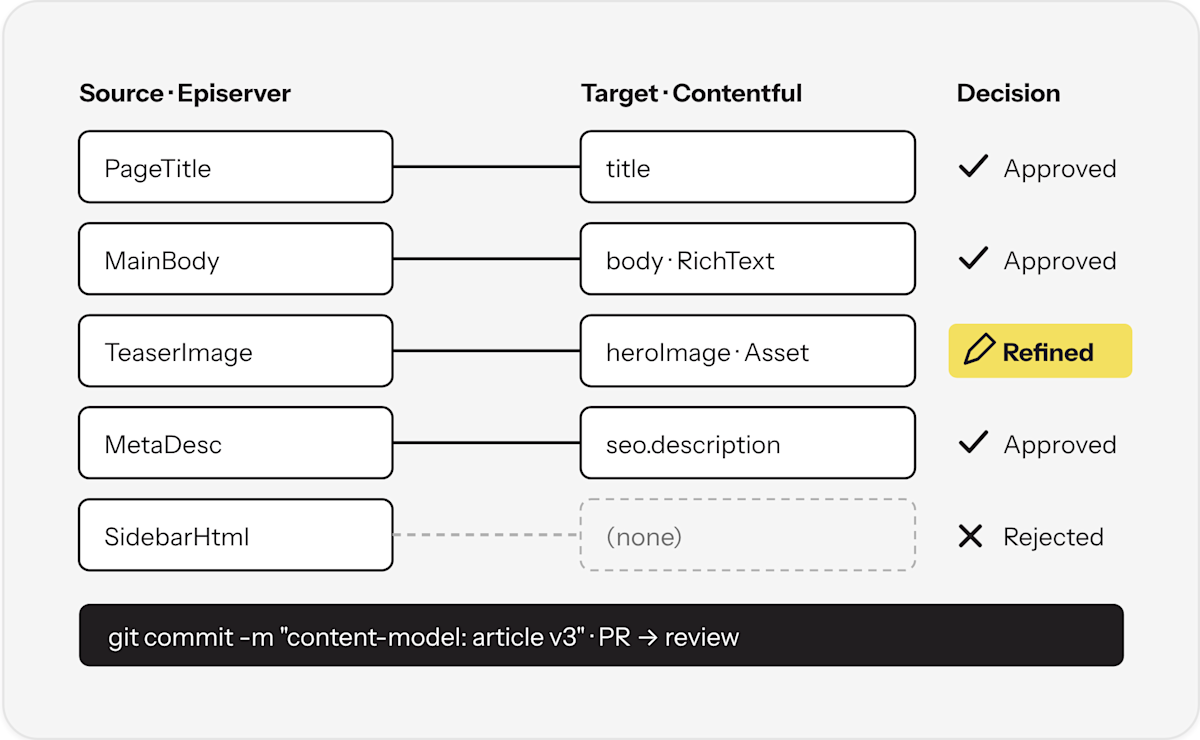
Agents draft how the source structure maps to the target schema, reading both sides. Your team and ours approve, reject, or refine each mapping.
The content model lives in code and gets committed and reviewed like any other engineering change.
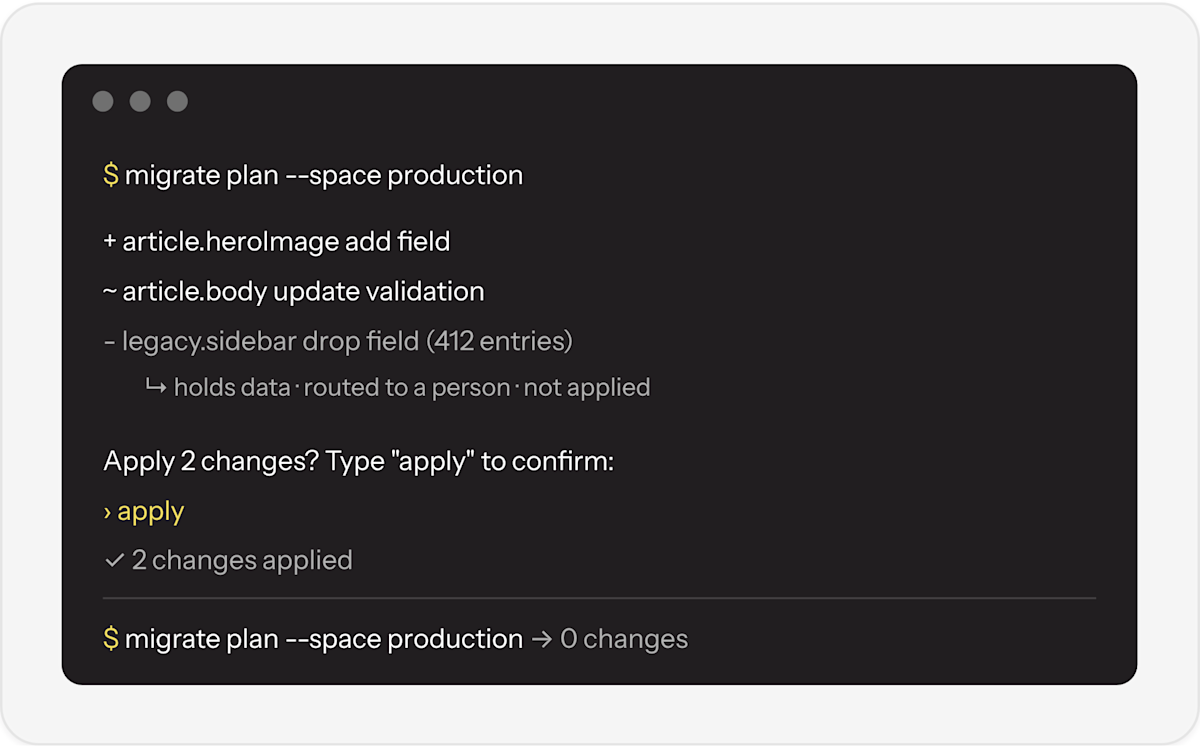
4. Changes to the live space follow diff-then-apply
The full diff prints before anything is sent, applying it takes a typed confirmation, and running the same migration twice changes nothing the second time.
Destructive operations, such as deleting a content type or dropping a field that holds data, go to a person and never run on their own.
5. Run extraction and loading as a coordinated set of agents
Each agent handles a schema, a component, or a page, and extraction and transformation run in parallel for each source system. Progress is visible in real time.
Failed records retry automatically, and anything that still fails is flagged for review as a recoverable record.
6. Check all of it
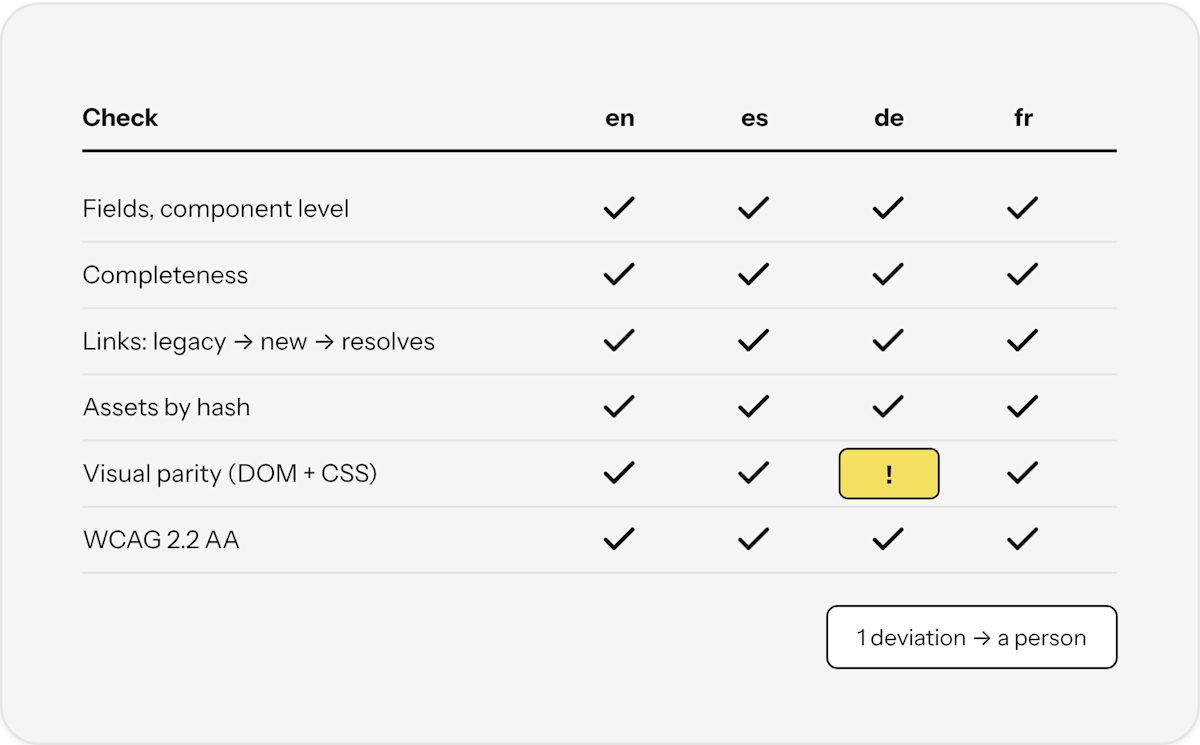
Source and destination are compared field by field at the component level, using the structural mappings. Completeness checks confirm nothing user-facing was dropped, and every deviation goes to a person, because some gaps are intentional pruning and some are defects. Links are validated in two steps: each legacy URL maps to the right new URL, and each new URL resolves.
Assets are verified by hash against the source. Visual parity is checked by comparing DOM structure and rendered CSS per component, against a design reference when there is one. An accessibility module checks alt text, headings, and ARIA handling against WCAG 2.2 AA. The full suite runs for every locale, and people review a prioritized set of pages plus every flagged deviation.
7. Rehearse until cutover is routine
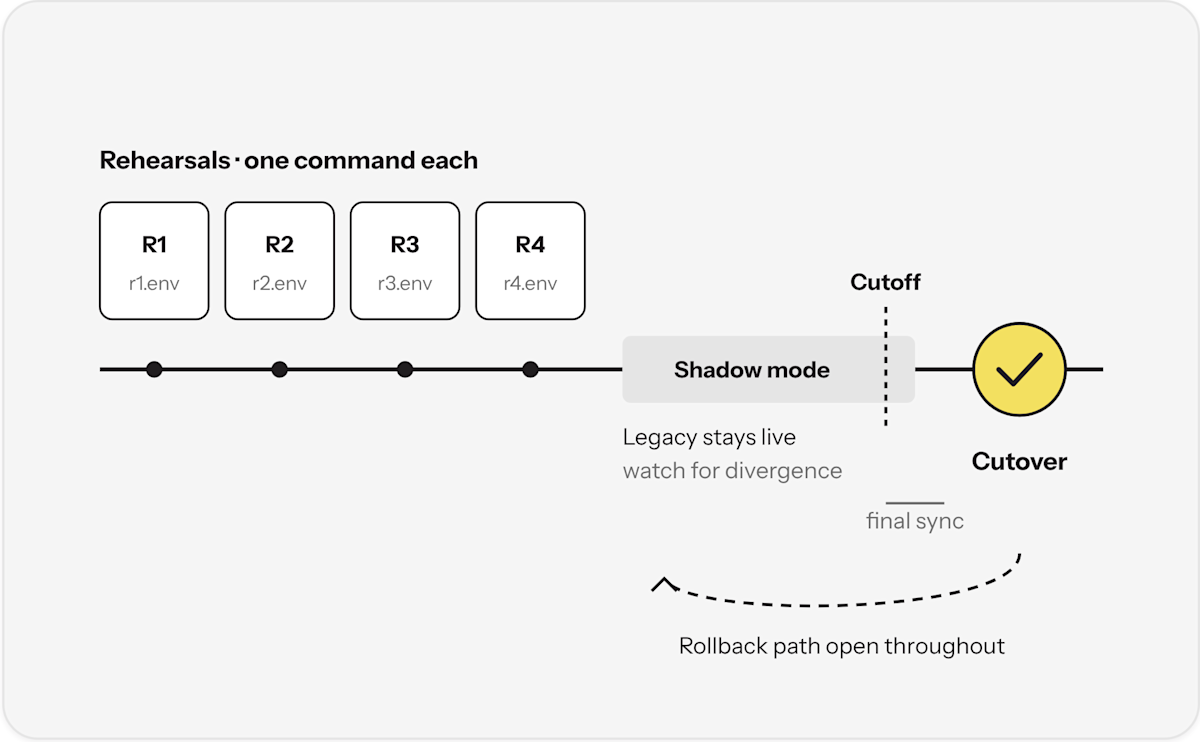
Because the pipeline is automated and reruns change nothing, a full rehearsal costs one command. The team runs rehearsals repeatedly, each in an isolated environment with its own URL.
Cutover starts in shadow mode with a set cutoff date while the legacy site stays live. The team watches for content divergence, runs a final sync for anything created in between, and keeps a rollback path open throughout. If something goes wrong, traffic goes back to the old site.
Where the effort goes
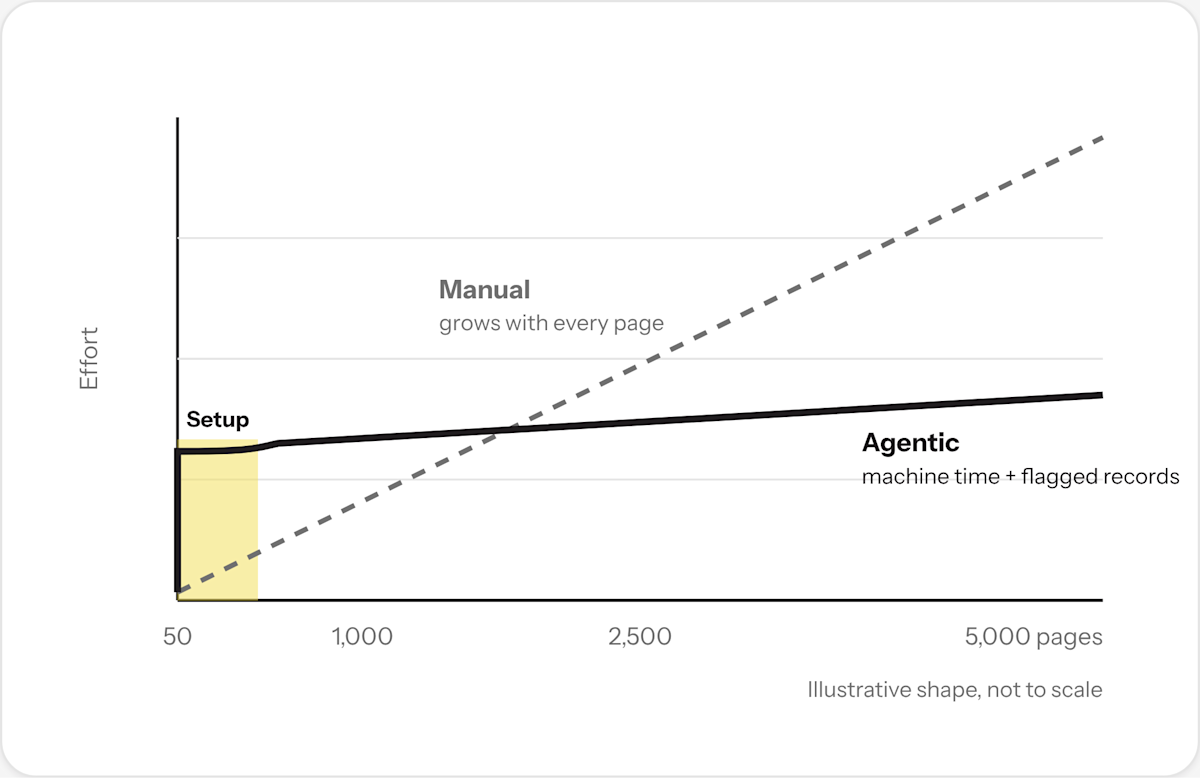
In a manual migration, every cost grows with page count: reading, entering, linking, checking. In an agentic migration, most of the effort goes into setup: the crawl standards, the constitution, the mappings, and the validation rules.
After that, each additional thousand pages adds machine time and a short list of flagged records for people to review. Three things follow from that shift.
Page 5,000 gets the same treatment as page 50
Over thousands of pages, a manual team’s attention fades and conventions drift from one person to the next. An agent pipeline applies the same rules and validation gates to every page.
When a page fails, it shows up before launch as a flagged, recoverable record.
Verification covers the whole site
Manual projects check samples because checking everything takes too many hours. When every field, link, asset hash, and locale is checked by machine, the whole site gets checked.
Rehearsals follow the same logic. The team repeats them until cutover holds no surprises, and that repetition is where most launch risk gets removed.
A small senior team carries the work
Zaelot staffs these migrations with a small group of senior engineers, in line with how the company staffs overall: roughly three senior professionals for every non-senior. Their time goes to approving mappings, adjudicating flagged deviations, and shaping the taxonomy with your team.
Your content strategy and priorities set the direction, and the pipeline carries them out.
Spend the effort on the content
Once the mechanical work is automated and verified, the hours that used to go into copy and paste can go into the content itself. That can mean:
- •
A taxonomy your team can maintain
- •
A cleaner URL structure with legacy redirects in place
- •
Accessibility debt paid down
- •
Metadata and structured data done properly
We hand back something better than we found.
When checking every page costs machine time, the migration budget can go toward making the content better.
Has a migration been waiting on your roadmap?
Zaelot is glad to walk your team through the pipeline and share what we’ve learned from similar moves. Talk to our team.
About the author
Ramiro Visca, AI Practice Lead, Zaelot
Ramiro leads Zaelot’s AI practice, the group that designs and runs the agentic pipelines described in this piece. His team builds the crawl standards, the constitution, the agent orchestration and the validation suite, then puts them to work on real migrations alongside client content teams.
His focus is the part most automation skips: deciding which rules the agents follow, where a person has to stay in the loop, and how to prove the result is complete before anyone flips the switch.